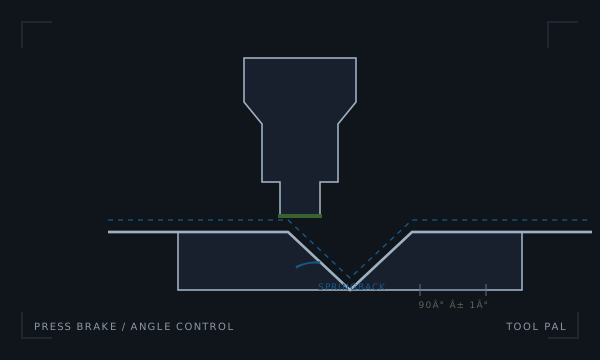
Press brake tooling: read the load before you bend
Tonnes per metre, V-opening and material thickness decide the tool — not the other way around.
TOOL PAL · Field note
A TOOL PAL turret punch tool passed 1.5 lakh hits and a full load test, and is still running. Here is what that result does — and does not — tell you about your own tooling.
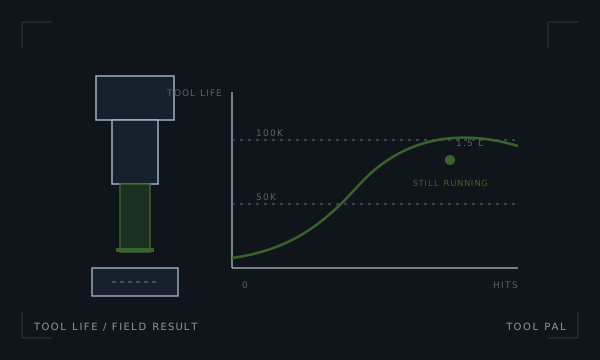
Tool life numbers travel badly. A figure that is real on one press can be meaningless on another. So when we say a TOOL PAL turret punch tool passed 1.5 lakh hits and a load test — and is still running — it is worth being precise about what was measured and what it depends on.
A customer needed production tooling for a turret punch operation. The requirement was not simply a punch that produced the right shape on the first stroke. The tool had to hold the feature over a long run, survive a load test, and remain serviceable when it eventually needed attention.
We developed the tool, ran the trial, and kept it in production. The 1.5 lakh figure is a field result from that programme, not a laboratory projection.
Tool life is a system outcome. The punch and die are the parts that wear, but they are not the only variables:
Do not ask only “how many hits will this tool last?” Ask “on which press, in which material, at what clearance, with what regrind interval?” A tool life claim without those conditions is a marketing number.
There is no single feature that produced the result. The tool was specified as a system:
At the time of writing, the tool has passed 1.5 lakh hits and a full load test and is still running. We treat that as a validated starting point, not a guarantee. Life will move with the material, coating, machine condition and maintenance routine on the next application.
What the result does prove is that the design, build and trial route can produce a tool that survives production. That is the part we can repeat.
| Check | Why it matters |
|---|---|
| Hit count | Production counter, reconciled against dispatch — not an estimate. |
| Hole size and shape | Sample measurement at intervals; drift shows before failure. |
| Burr height | The exit-side burr is an early indicator of clearance and wear. |
| Strip and surface marks | A marking tool is often a stripping or guidance problem. |
| Punch and die wear | Edge condition and clearance check at each regrind. |
| Load test | Proves the assembly, not just the cutting edge. |
“A tool life number is a record of a specific tool on a specific press. Ask for the conditions before you compare it.”
TAC PAL is a young company. This is one validated result, not a catalogue of ten thousand. What we can offer is the method behind it: design around the application, build and inspect in-house, trial before release, and document what happened.
If you have a turret punch application where the current tool is not lasting, send the press, the material, the feature and the failure mode. We will tell you where we would start.
Send the press, the material and the feature. We will review it against the tooling route.
Keep reading
More from the application team.
Tonnes per metre, V-opening and material thickness decide the tool — not the other way around.
Volume, part size and press capacity decide more than the tooling price does.
Next step
We will review the application and tell you what the tool has to survive before we quote it.